A Fresh Start—There Is No End to My Practice
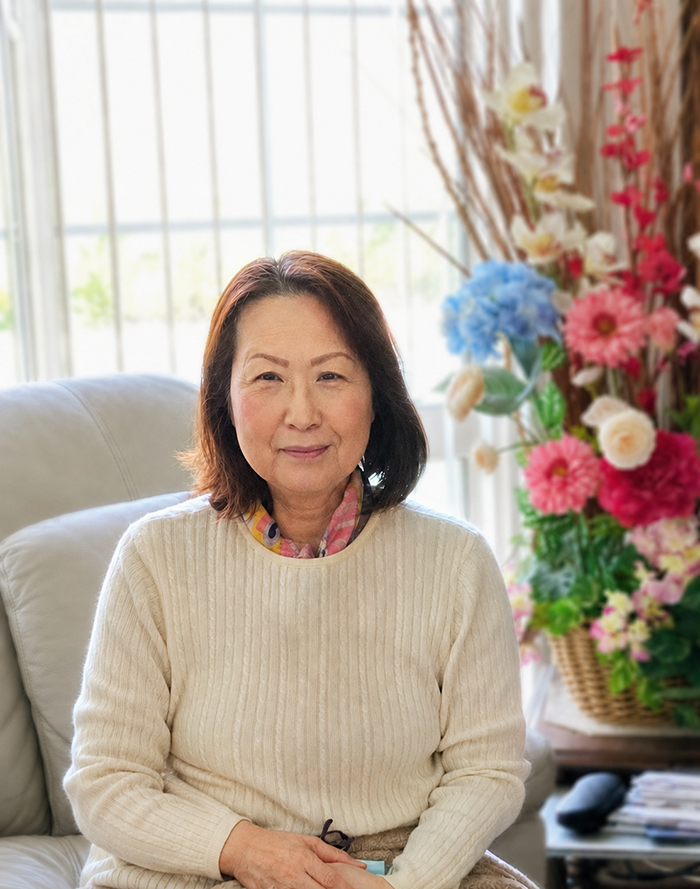
Ms. Naomi Masuno
Rissho Kosei-kai of Los Angeles
When and how did you first encounter the faith of Rissho Kosei-kai?
I was born and raised in Osaka. I married in 1980, and because the family I married into belonged to Rissho Kosei-kai’s Osaka Dharma Center, that was my introduction to the faith. My husband and his parents were all devoted members, so our home was constantly filled, day and night, with local members and youth leaders coming and going.
The year after we married, in 1981, we were blessed with our eldest son. However, during the economic boom of the late 1980s, my husband became caught up in its extravagant lifestyle. He frequently stayed out overnight, returning home in the morning, and our relationship gradually deteriorated. As he showed little concern for our family, I began to think, “I can’t go on living like this. If possible, I want a divorce.” Eventually, I took our son and lived separately from my husband for a time.
Concerned about my situation, the local group leaders and area leaders frequently came to visit and offer support. At first, I pretended not to be home. But members of the sangha—my fellow practitioners—continued to come to my apartment, and I was deeply touched by their kindness and compassion. Little by little, I began visiting the Osaka Dharma Center with my young son in tow.
At the Dharma center, the leaders would warmly ask me, “How have you been lately? Is anything troubling you?” and “If something happens, don’t hesitate to tell us.” They cared for me and also helped look after my young son. Thanks to their support, I gradually began attending Memorial Day services and participating in Dharma center duties.
The members of the sangha truly stood by you during the most difficult time in your life.
I continued trying to talk with my husband and brought him divorce papers many times, but each time he tore them up. Overwhelmed by anxiety and unsure of what to do, I confided in my chapter leader about the difficulties in our marriage.
She said to me, firmly but compassionately, “The difficulties with your husband are a form of practice that you need at this point in your life. Getting a divorce may be easy, but unless you change your own heart, you will experience the same kind of suffering again. Entrust to the Buddha whether or not you will ultimately divorce, and for now, devote yourself wholeheartedly to Buddhist practice.” Trusting her words, I earnestly engaged in member visits and Dharma circle practice, taking a deep and honest look at my own heart. Then, before long, something unexpected happened. My husband, who had stubbornly refused to divorce me for so long, readily signed the papers. We agreed that I would have sole custody of our son and that there would be no child support or financial settlement. Our divorce was finalized in 1991, and each of us began a new chapter in life.
Afterward, raising my son on my own brought financial hardship and many other painful challenges. Although I had the determination and strength to protect my child, there were times when I felt that I might break down. Whenever that happened, members of the sangha were always there to encourage me and stand by my side.
It is only because of the support of so many people that I was able to work for a life insurance company during the day and serve as the head of the young women’s group for my chapter in the evenings, visiting and supporting members, all while raising my son. I also participated in training retreats in Ome and pilgrimages to Mount Shichimen, devoting myself wholeheartedly to youth activities.
Looking back now, I am deeply grateful that my son grew up close to the Buddha from an early age and became a sincere and kindhearted person.
Please tell us how you eventually came to move to the United States.
In February 1992, the year after my divorce, I traveled to Las Vegas with a friend from my school days. There, in what seemed like an encounter guided by destiny, I met the man who is now my husband.
At the time, he worked for a travel agency in Los Angeles and was guiding tourists in Las Vegas. When we told him that we had come from Japan on vacation, he took us to one of his favorite restaurants. Although we had only just met, we immediately hit it off and enjoyed a wonderful meal together before saying goodbye.
Then, three days later, my friend and I happened to meet him again. It felt like something out of a movie or a novel. The coincidence was so extraordinary that I sensed a powerful connection between us. After sharing another meal, I gave him my telephone number and said, “If you ever have an opportunity to visit Osaka, please contact me.” My friend and I returned to Japan the following day.
About six months later, he actually came to Osaka for work, and we had a very moving reunion. That unexpected series of events brought us together. Both of us had previously been married and were single at the time, and we married in November 1993.
When he proposed, I honestly told him, “Even after we marry, I will continue practicing the faith of Rissho Kosei-kai. And my son, who is irreplaceable to me, will be coming with me.”
Because he had once lived in Suginami, Tokyo, he was familiar with Rissho Kosei-kai’s Great Sacred Hall. He had lost both of his parents, and the opportunity to honor his ancestors in the United States was meaningful to him. He therefore respected my wish to continue practicing the Rissho Kosei-kai faith and, of course, wholeheartedly welcomed my son as well. In May 1994, I moved to the United States with my son, who was then in his second year of junior high school.

You went on to serve as head of the Japanese-speaking group at the Los Angeles Dharma Center, didn’t you?
Beginning in 2003, I simultaneously served as an area leader and leader of the women’s group. Then, in 2007, I was appointed head of the Japanese-speaking group, a role I served in for nearly twenty years.
When I first moved to the United States, I often felt bewildered by the differences in culture and customs. I also noticed differences between Japan and the United States in the way members approached their practice.
Japanese culture tends to value cooperation and harmony. For example, when receiving guidance from a leader, many people in Japan may respond with “Yes, I understand” or “That’s right” in agreement. In the United States, however, people are generally encouraged to express their own views clearly, saying, “This is what I think” or “This is how I see it.”
This does not mean that one approach is better than the other. Through interacting with members in the United States, I learned how important it is to recognize, respect, and understand the differences in each country’s culture, values, and ways of thinking.
My home in Palm Springs is about two hundred kilometers from the Los Angeles Dharma Center, and the drive takes approximately two hours. When I was younger, I would make day trips to the Dharma center. Now, when I participate in monthly Dharma center duties and other activities, I usually stay overnight.
On my way to the Dharma center, I have also made an effort to invite and drive members who live far away and have babies or young children so that they, too, can participate in Dharma center duties and Memorial Day services. Through the responsibilities entrusted to me, I have deepened my own faith. At the same time, remembering how the sangha once supported me, I have always tried to stand beside people in their pain and sorrow. With that intention, I have formed meaningful relationships with many members over the years.

Is there a particular teaching of Rissho Kosei-kai that you always keep in your heart?
I deeply cherish the teaching, “If one changes, others will change accordingly.” When I first married my present husband, I sometimes spoke to him unconsciously in a condescending way, as if to say, “Let me teach you how it is!” He responded, “I am not asking you to teach me.” His words made me realize how self-important I had been. I was reminded once again of how strongly attached I could be to my own way of thinking.
At the same time, the experience taught me the importance of learning from every encounter and every relationship. I came to understand that by learning from all the people and circumstances around me, I can change myself and continue to grow.
You stepped down as head of the Japanese-speaking group this June. How do you hope to approach your practice from now on?
President Nichiko Niwano often teaches us, “Make an effort, make an effort, I will keep on making an effort until I die, and if I am reborn, I will make an effort again.”
Although I have stepped down from my leadership role, my practice of the Buddha Way continues. I therefore intend to keep making diligent efforts each day toward the perfection of character described in the Members’ Vow.
One person I greatly respect is the late Kinuyo Grimmitt, a former chapter head of the Los Angeles Dharma Center. Even after stepping down as a chapter head because of her advanced age, she continued to drive members of her generation to the Dharma center and never failed to attend the monthly Memorial Day services. I regard Ms. Grimmitt as a true model of a person of faith. With the conviction that “there is no end to diligent practice” firmly in my heart, I hope to embark on this new chapter of life with a fresh spirit and continue practicing as one devoted follower of the Buddha Way.
