Becoming a Person of Faith Who Can Accept Everything as the Buddha’s Working
Ms. Wipaporn Patcharawit
Rissho Kosei-kai of Bangkok
When and how did you first encounter the faith of Rissho Kosei-kai?
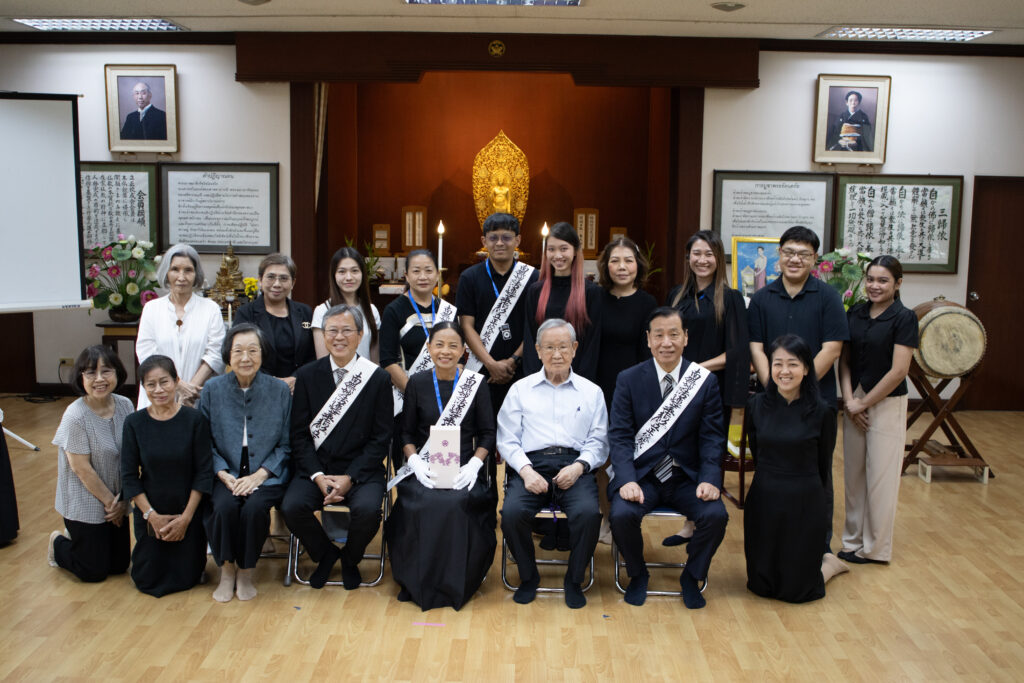
I first learned about Rissho Kosei-kai around 2002, when my mother-in-law, who was a member of the Bangkok Dharma Center, told me about it. At that time, however, I did not participate in any Dharma center activities. My first opportunity to take part in an activity came in 2008, when my sister-in-law, who was also a member, invited me to attend a family education seminar. I was six months pregnant at the time, and she enthusiastically encouraged me to attend, saying, “You’ll hear some wonderful talks at the seminar, and I’m sure they’ll be helpful as you raise the child you’re expecting.” Just as she had said, the lectures were easy to understand, featuring concrete stories about parents and children. I found many of the topics relatable and was deeply interested in what I heard.
I learned that family education does not involve anything extraordinary; rather, it is about our everyday interactions and communication with our children. From then on, I began participating in family education activities based on the principles of “learning from children” and “parents and children growing together.” At first, I attended as a participant, but gradually I became involved in organizing the activities. Eventually, I joined the volunteer team responsible for running the seminars.
So, it was through family education that you became involved in the activities of the Bangkok Dharma Center?
Yes, exactly. As may also be the case with lecture programs in Japan, here in Thailand, we do not explicitly tell the general public that our family education programs are based on Buddhist teachings. For example, rather than explaining the teaching of dependent origination directly, we focus on the importance of parents changing their own attitudes and the way they interact with their children first, rather than trying to change their children, as expressed in the idea that “when parents change, their children change.” As I continued studying family education, I gradually came to understand that the teaching of dependent origination lies at its foundation. I also came to realize that family education is truly essential for parents raising children. Today, in addition to helping organize family education seminars, I actively share the importance of family education with my friends and acquaintances.
You have served as the head of general affairs at the Bangkok Dharma Center this year. Looking back, could you tell us about any particularly memorable experiences from the roles you have undertaken?
I joined the Dharma center staff in 2017 and have primarily been responsible for general affairs. My roles have included preparing for various events and ceremonies and producing newsletters. Among these experiences, one in particular stands out in my memory. In preparation for the ceremony for the Anniversary of Founder Niwano’s Birth on November 15, 2018, I was researching the Founder’s life to prepare materials to distribute to those attending the ceremony. During my research, I came across the six vows that the Founder made when he was sixteen, while traveling by night train to Tokyo. The six vows are as follows:
- Never to lie.
- To work with all my strength.
- To undertake tasks that others find disagreeable.
- Never to struggle with others: no matter how severe my experiences, to hold the firm belief that they are all according to the wishes of the gods and buddhas.
- To work steadily and hard no matter whether others are observing me.
- No matter how unpleasant the task, to see it through once I have undertaken it.
As I reflected on each of these vows, I was deeply moved by the realization that the Founder had cherished and upheld them throughout his entire life, beginning when he was just a sixteen-year-old boy. I strongly resolved to make these six vows my own guiding principles in life and put them into practice.
This year marks the 120th anniversary of the Founder’s birth. What would you like to say to him today?
I would first like to express my joy and gratitude for having encountered the teachings of Rissho Kosei-kai by saying, “Thank you so very much, Founder.” At the same time, I vividly remember a talk given by former minister Rev. Shoko Mizutani about the Founder’s teachings in which he spoke of humility by drawing an analogy with rice plants bearing abundant grain. The Founder’s hometown, Niigata Prefecture, is one of Japan’s leading rice-producing regions, and Thailand is also a country where rice cultivation is widespread. In Japan, there is a well-known saying: “The heavier the ears of rice become with grain, the lower they bow.” Just as rice plants naturally bow their heads as their grain grows abundant and heavy, we too must cultivate humility as we grow as human beings. He taught us how important it is to remain grateful, reflect on ourselves, and continue learning. This is just one example, but I am sincerely grateful that the Founder always conveyed the truly important things in life and in our daily Buddhist practice in ways that are simple and easy to understand.
You received your Dharma Teacher qualification in October last year. How do you feel about this new role?
In the past, although I wanted to support members in any way I could and offer them appropriate advice, I often felt anxious and hesitant, wondering, “Am I really capable of doing this?” However, since receiving my Dharma Teacher qualification, I have gradually experienced a change in my attitude. The turning point was some warm words of encouragement from the present minister, Rev. Yukimasa Hagiwara. He told me: “You are a Dharma Teacher now, so you can have confidence in yourself. Please continue listening attentively to those who are struggling, and support as many people as possible in establishing a connection with the Buddha’s teachings.” I have kept those words close to my heart. Now, I want to cherish the connections I make with people each day and draw on the knowledge and experience I have gained to share the Buddha’s teachings with confidence.
What do you find most appealing about Rissho Kosei-kai?
I believe the greatest characteristic of Rissho Kosei-kai as a lay Buddhist organization is that it teaches us to put Buddhist teachings into practice in our homes, workplaces, and local communities. It also makes Buddhism and the Lotus Sutra, which are often considered difficult to understand, accessible and practical for anyone at any time. For example, the Founder always conveyed the essential points of Buddhism in simple expressions, teaching us that “If you change, others will also change,” based on the teaching of dependent origination, and “Put others first” as the basis of bodhisattva practice.
President Niwano has also taught us the importance of cultivating our minds through the Three Practices:
- Exchange morning greetings.
- Respond clearly and positively when someone calls us.
- Push our chair back under the desk when we leave our seat and arrange our shoes together neatly.
Through these simple practices, we learn to value basic courtesy and good daily habits while cultivating our inner selves. As the expression “One’s faith is manifested in one’s life” suggests, I believe the greatest appeal of Rissho Kosei-kai is that it helps us bring the Buddha’s teachings into our everyday lives and put them into practice.
Finally, could you tell us about your goals for your future practice?
In his Dharma talks, the Founder taught us that “Everything is the Buddha’s working” and “Everything is a gift from the Buddha.” Keeping these words in my heart, my goal in Buddhist practice is to become a person of faith who can accept the various trials and hardships of life as opportunities for awareness, learning, and personal growth. I may sometimes receive difficult requests for advice from members in the future. Whenever that happens, I want to remember the Founder’s six vows, do everything within my power, and continue making sincere efforts each day so that I can be of help to others in any small way.