
Chapter 2: Expounding the Dharma
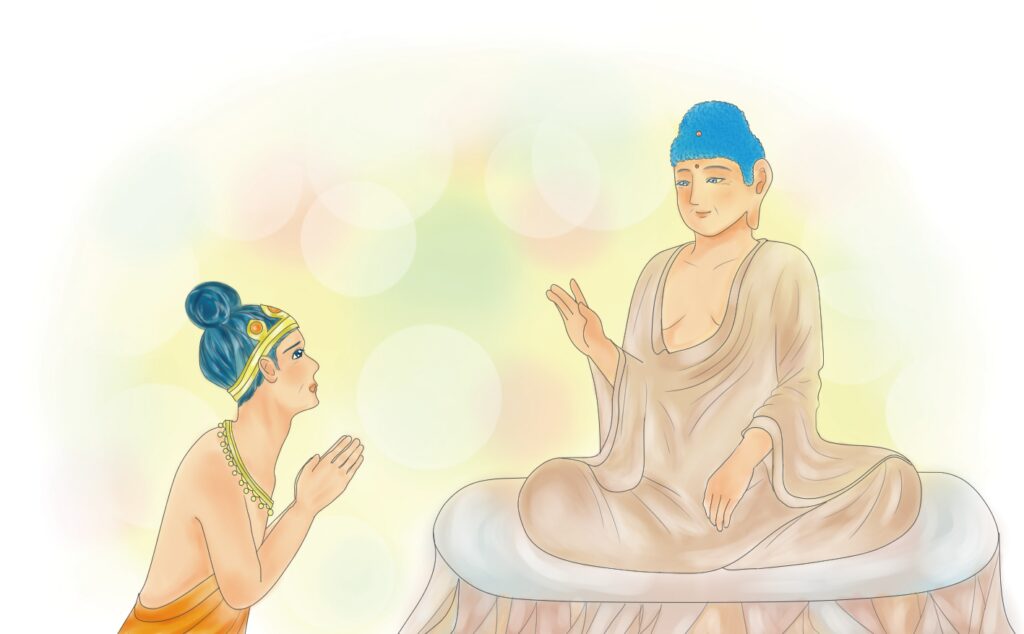
The Bodhisattva Great Adornment now leads the assembled bodhisattvas in asking the Buddha what they should practice as bodhisattvas to accomplish Supreme Perfect Awakening without deviation. Shakyamuni responds to his question as follows.
Tranquil and Empty in Nature and Attributes
“The doctrine of Innumerable Meanings is the way that leads all to accomplish Supreme Perfect Awakening. In order to understand the doctrine, to begin with, we should perceive the following truth.
“All things in this world are equal and always in a state of great harmony. Among the phenomena we observe with our eyes, we may see that all things are large and small; appearing and disappearing; fixed and moving; different and changing in every way. But it must be perceived that, fundamentally, they are all based only on one truth (One Dharma), just like emptiness, which is everywhere the same.”
This is the teaching of “All things are tranquil and empty in nature and attributes.”
“Nature” indicates the properties or characteristics of things, and “attributes” refers to the observable aspects of those properties or characteristics.
“Emptiness” means that all things exist in the Dharma of dependent origination, and there is not a single thing that is absolute or at the root of all things. Therefore, it also means all things are, in essence, equal. “Tranquility” indicates the state of being in great harmony. In other words, it is the ideal and non-static state in which all things are continuously developing in great harmony.
Having stated this truth that “All things are tranquil and empty in nature and attributes,” the Buddha goes on to say that few perceive this truth, and that people see only the apparent forms before their eyes. They make false and arbitrary assessments, supposing that “this is a gain,” and “that is a loss.” Giving rise to such unwholesome ideas and creating all sorts of bad karma, they are thereby unable to free themselves from the realm of error, in which they experience much suffering and pain.
Bodhisattvas should perceive all of this clearly, give rise to heartfelt sympathy and great compassion, and determine to relieve the suffering of all living beings. To this end, practice is essential to perceive in all its depth the true and real aspect of all things. Thus, the cause of human suffering is shown, and the mental attitude of the bodhisattva who would liberate living beings from suffering is made clear.
The Buddha then instructs the bodhisattvas to observe closely the differentiated state of all things and their state of constant change. The Buddha expounds it in detail as follows.
The Innumerable Meanings Arise from the One Dharma
It is essential to grasp the faculties, natures, and desires of living beings, and as living beings’ natures and desires are innumerable, so are the ways of teaching them the Dharma innumerable.
But though the teaching is thus infinitely varied, the innumerable meanings arise from the One Dharma, and this One Dharma is, namely, the state of having no attributes. Such absence of attributes is totally undifferentiated and makes no differentiation. As it makes no differentiation, all things are equal, and this state is called “ultimate reality.”
Here, the meaning of the term “ultimate reality” in Buddhism is made clear. Ordinarily we understand this term to mean simply the real attributes of things, but it is important at this point to remember this deeper sense of the term, when we encounter it in such expressions as the “ultimate reality of all things.” Therefore, here, it is still impossible for ordinary people to actually understand what “ultimate reality” really means.
The Bodhisattva Great Adornment continues to ask the Buddha as follows. “World-Honored One, you have now expounded the teaching of Innumerable Meanings again. (Although we understand that this teaching is fundamentally the same as what you taught before), in what way is it different from what you expounded in the past? What is the reason that you are now declaring that a bodhisattva who practices the teaching of Innumerable Meanings is certain to quickly attain the highest awakening?”

The Buddha Has Not Yet, in These More Than Forty Years, Fully Revealed the Truth
In response, the Buddha observes that after he attained enlightenment under the Bodhi tree and gazed upon the world, the conclusion was inescapable that, in their present state, living beings were not prepared to have enlightenment explained to them. For this reason, he sought to lead living beings to their own liberation by preaching to them in a fashion appropriate to their circumstances, faculties, natures, and desires.
Continuing in this fashion to teach within the bounds of their understanding, the Buddha has not yet had the occasion to reveal the innermost truth of the Dharma, and thus more than forty years have passed without a complete explanation of the ultimate truth.
Yet all that has been taught until now is founded on the truth. Like water, which everywhere is water and yet differs as does the water in a valley stream, a ditch, a pond, or the ocean, the teachings at the beginning, midway, and now have not been exactly the same. Although the words may appear the same, there have been increasing depths of meaning.
The truth that all the buddhas have taught is only one. The manner of explaining this one truth has been as varied as the many things people have sought in their minds. Furthermore, the body, or ultimate substance of the buddhas, is one. It changes into countless bodies, and each of these displays countless changes in its working. This is none other than the inconceivable realm of the buddhas. It is a realm that is hardly known even to the bodhisattvas verging on buddhahood, let alone to shravakas—those who practice intellectually and pratyekabuddhas—those who practice experientially. It is a realm to be explored in depth only upon attaining buddhahood, a realm to be known to none but buddhas. One who would gain the enlightenment of a buddha must go deeply into these Innumerable Meanings and master them.
Indeed, that is so. When we are taught that all things are tranquil and empty in nature and attributes, and they all arise from the One Dharma, most of us probably get only a vague, general idea. But no one can affirm that he understands it clearly and fully. If you want to perceive it clearly, you must gain the knowledge and wisdom that are one with those of the Buddha. Then one is oneself a buddha. That is why the Buddha said in chapter 2, “Skillful Means,” of the Lotus Sutra: “Only a buddha together with a buddha can fathom the ultimate reality of all things.”
But this does not mean that we should despair. At the time of the sermon that comes to us as the Sutra of Innumerable Meanings, not even Shariputra, the disciple who was first in wisdom, had attained enlightenment. And so it was that later, when he taught the Sutra of the Lotus Flower of the Wonderful Dharma, the Buddha patiently explained the Dharma in order that all living beings might be brought to enlightenment. So it does not matter if one does not perfectly understand the Sutra of Innumerable Meanings. It is enough at this stage to keep in mind, even if only faintly, the meaning of the “ultimate reality” of all things.
This is an English translation of text originally appeared in Japanese in Hokke sanbu kyo: Kaku hon no aramashi to yoten, (Kosei Publishing, 1991 [revised edition, 2016], pp. 16–23).